
NEWS
TikTok prank based on real fraud scheme: How cybercriminals convince victims to call them

July 18, 2022 2:17 p.m.
On TikTok, a prank where people call their friends using an automated answering machine voice to tell them that a large amount of money is about to be debited from their account is gaining popularity. Kaspersky experts warn that this trend is a real fraud scheme, called vishing, and is actively used by cybercriminals.
Kaspersky researchers detected an increase in the number of vishing emails in June (almost 100,000 total) and collected approximately 350,000 vishing emails between March and June 2022. They also explained how vishing works and how to avoid falling into this trap of cybercriminals.

Vishing (short for voice phishing) is the fraudulent practice of convincing individuals to call cybercriminals and reveal personal information and bank details over the phone. Like most phishing schemes, it starts with an unusual e-mail from a large online store or a payment system. For example, it could be a letter from a fake version of PayPal telling you that they have just received a request to withdraw a large amount of money from your account.
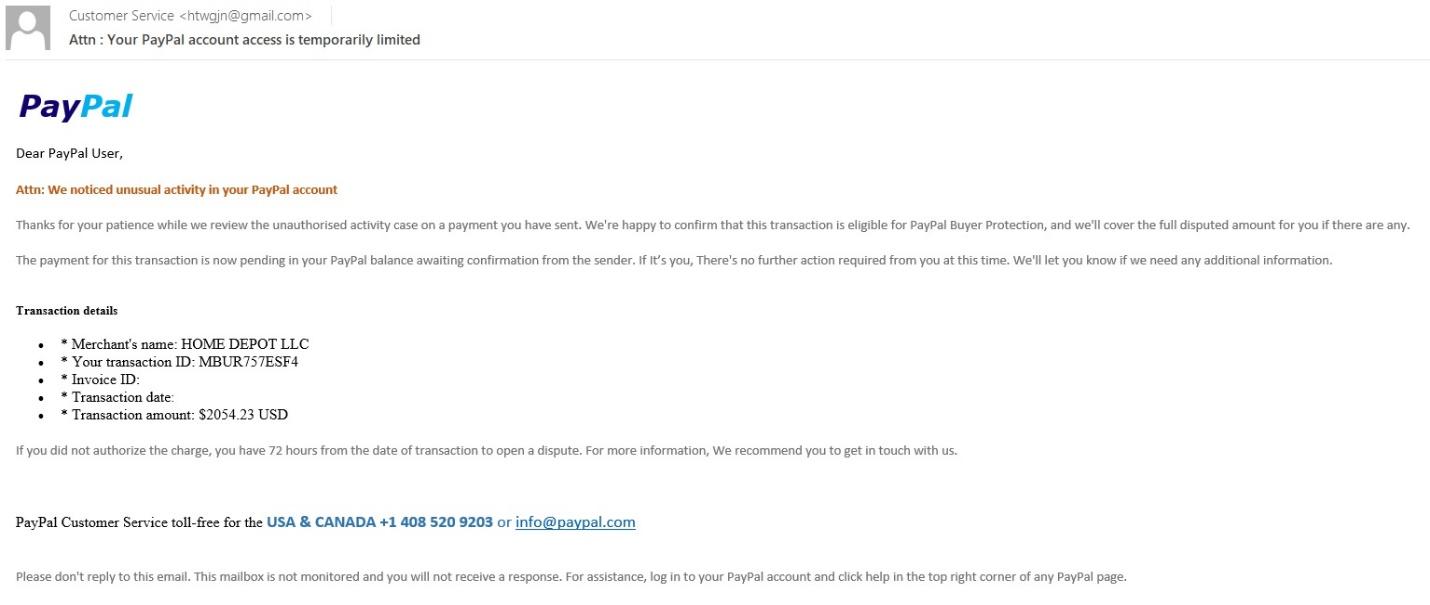
Fake notification from PayPal about a purchase for a large amount of money
But here’s the difference: while regular phishing emails ask the victim to follow a link to cancel the order, vishing emails ask that they urgently call the customer support number provided in the email.
Kaspersky experts emphasize that this method was intentionally chosen by cybercriminals because when people look at a phishing site, they have the time to think about their actions or notice signs that the page is not legitimate. But when victims talk on the phone, they are usually distracted and find it more difficult to focus.
Under these circumstances, attackers do everything they can to further throw them off balance: rushing them, intimidating them, and demanding that they urgently provide their credit card details to cancel the supposed fraudulent transaction. After gaining the victim’s bank account details, cybercriminals use the information to steal their money, leaving the victim with an empty wallet.
Kaspersky experts highlight that in the last four months (from March to June 2022) they have detected almost 350,000 vishing emails, asking victims to call in and cancel a transaction. In June, the number of such emails increased, reaching nearly 100,000, leading Kaspersky researchers to predict that this trend is only gaining momentum and is likely to continue growing.
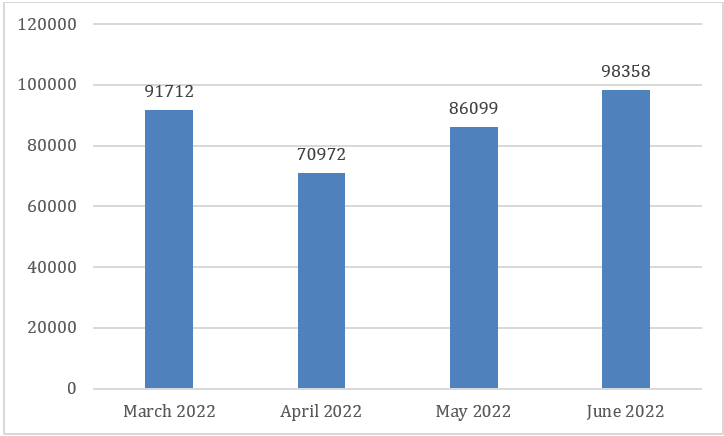
Number of detected emails with vishing, March — June 2022
Curiously, TikTokers actively repeat one of the vishing schemes, with the only difference being that they do not send a fraudulent email in advance, nor do they steal anything from their victims – their goal is a show, not money.
The call is conducted through an answering machine, whose voice is generated with an online translator. Most often, pranksters introduce themselves as a representative from the customer service department of a large online store, claiming they have just received an order from the victim for several thousand dollars and asking for their confirmation. No matter how the victim replies, the next thing the answering machine says is, “Thank you, your order has been confirmed.” People think the answering machine misheard them and that the funds are going to be withdrawn from their account immediately, so they panic, scream, and don’t realize that they are being pranked.
When people are convinced to disclose their personal data during a phone call rather than on a phishing page, they often don’t have the chance to consider that they are the target of a hoax – and a large number of TikTok videos with this prank are a prominent example of this.
“I often come across videos on TikTok of bloggers pranking other people by calling them and telling them that their account is about to be debited thousands of dollars. The victims believe it and go crazy over it. When you look at these videos on your phone you think, “How can anyone fall for such a thing?” But when people encounter scam calls in real life, they are often affected by multiple circumstances at the same time. Such a call can catch them off guard, while their head is full of other things and they can’t clearly assess who is on the other end of the call – a prankster, a fraudster or a real bank security specialist,” comments Roman Dedenok, security expert at Kaspersky.
Read about other popular methods of email fraud in the full report on Securelist.
To protect yourself from vishing, Kaspersky recommends:
- Checking the sender’s address. Most spam emails come from addresses that don’t make sense or appear as gibberish, for example, amazondeals@tX94002222aitx2.com or something similar. By hovering over the sender’s name, which itself may be spelled incorrectly, you can see the full email address. If you’re not sure if an email address is legitimate or not, you can put it into a search engine to check.
- Considering what kind of information is being requested. Legitimate companies don’t contact you out of the blue via unsolicited emails to ask you for personal information, such as banking or credit card details, your Social Security number or other sensitive data. In general, unsolicited messages telling you to “verify account details” or “update your account information” should be treated with caution.
- Being wary if the message is creating a sense of urgency. Spammers often try to apply pressure by using this tactic. For example, the subject line may contain words like “urgent” or “immediate action required” to pressure you into acting.
- Checking for grammar and spelling is an effective way to identify a scammer. Typos and bad grammar are red flags. So too are odd phrasing or unusual syntax, which might result from the email being translated back and forth through translators several times.
- Installing a trusted security solution and following its recommendations. The secure solution will then solve most problems automatically and alert you if necessary.










NEWS
Gen Z is Google’s most active users as AI transforms Search into an intelligent partner

6:50 p.m. April 26, 2026
Gen Z is now the most active generation on Search, a trend clearly reflected in the way people across Southeast Asia including Philippines are engaging with the platform. AI is taking Search beyond its foundation of providing information, transforming it into a truly intelligent partner.
Powered by Google’s most advanced multi-modal reasoning model Gemini 3.1, Search can have an intuitive, back-and-forth conversation and it will get people’s complex and highly nuanced intent.
As AI natives, this shift resonates with Gen Zs. They are no longer just entering keywords, they are researching, planning, brainstorming, and even having conversations with Search. AI-powered features like AI Mode and Search Live make it faster, more natural, and more intuitive to find and act on information, allowing people to search in multimodal ways including text, voice and visual. As a result, Gen Z has emerged as the most active generation on Search. Signed-in users globally aged 18 to 24 now issue more daily queries than any other age group. Google sees over 5 trillion searches annually with Gen Z driving this growth, showing Search is more relevant than ever
The Philippines’ young, AI-native population uses Search to expand their world and make decisions they can trust
In the Philippines, this shift is even more undeniable.
The country has one of the youngest, most AI-native populations in the world. Gen Zs lean heavily into Search, with 89% using it every day to make smarter, more intentional choices for a wide array of decisions. From researching on upcoming travel destinations to exploring the latest trends, this generation relies on Search to navigate the journey from curiosity to the final checkout—ensuring that they always make decisions that are guided by the reliable information they find online.
These days, social media might be where Gen Z discovers a trend, but Search is where they deep-dive about it and fact-check it. Instead of simply following a viral hype or long queues, they use Google reviews on Maps to find the truth behind the filter. They rely on Search to look up a brand’s history, find honest feedback, and compare prices to see if a product is actually worth the buzz. Search provides the credibility they need to make a move.
That’s because Search remains grounded in trust. When people use Search to ask questions, Google cross-checks AI responses and provides clickable sources for quick validation.
“As a travel content creator, I use Google Search a lot! I use it for my flights, not just to find a good deal, but to check which ones have less impact on the environment. It’s my way of traveling a bit more responsibly,” said popular Filipino content creator Arshie Larga.
“Plus it is my filter to avoid tourist traps! When I see a viral restaurant or food on social media, I make sure to consult Google Reviews,” he added.
“AI is the best thing that has happened to Search. Today, it can do much more than just provide information. AI is making Search more intelligent so it can converse interactively across formats and provide answers to people’s complex and nuanced questions. In Southeast Asia—home to one of the world’s youngest, most AI-native populations—we are seeing this shift play out in real-time. For this generation, Search has become a constant companion. They are engaging more deeply, visually, and through voice than any group before them. Whether it’s for learning, exploring a personal passion or making a high-stakes purchase, they rely on Search to make decisions they can trust,” said Sapna Chadha, Vice President, Google Southeast Asia and South Asia Frontier
Search is a natural extension of Gen Z fandoms and culture
For Gen Zs, Search is more than a utility. It is a digital home for their daily lives and passions. When it comes to what they love, Google is a natural extension of their fandoms, turning their curiosity into an immersive experience through hidden moments in Search called Easter Eggs.
From interactive trivia quests for icons like Taylor Swift, BTS, and the Southeast Asia Coachella sensation BINI, to adorable viral sensations like Punch the Monkey, Search speaks the language of Gen Zs. More than an intelligent engine, Search is part of the world that Gen Zs love.
Beyond these curated moments, Search reflects the real-time heartbeat of Gen Z culture through Google Trends. When a conversation starts buzzing, Trends allows people to tap into the pulse of the dialogue, providing the insights they need to join in and take action.
For Filipino Gen Z, nothing proved more powerful and buzzworthy than BINI ahead of their historic appearance at this year’s Coachella. “BINI Coachella” reached the top of the trends globally, as their “BLOOMS” fans celebrated the group bringing Southeast Asian Pride to the world stage.
To celebrate this historic momentum, Search on mobile now features a special tribute: searching BINI anywhere in the world triggers their signature ‘Ey’ gesture– the viral ‘hang loose’ write flick symbolizing confidence and positivity. It’s a testament to how Gen Z still trusts Search to open a whole new world of information and immersion for the culture, fandoms, and everything that they’re passionate about.
NEWS
Motorcycle taxi riders urge government to protect livelihoods, enact motorcycle taxi bill

1:11 p.m. April 25, 2026
Motorcycle taxi riders are calling on regulators and legislators to ensure that the protection of rider livelihoods remains at the center of any regulation governing the motorcycle taxi industry.
In a statement, Motorcycle Taxi Community Philippines chairman Romeo Maglunsod thanked the government for extending assistance to riders amid the continuing fuel crisis, saying the ₱5,000 aid provides meaningful relief for workers whose daily earnings are heavily affected by rising fuel costs.
“We are grateful for the assistance extended by the government to riders during the fuel crisis. For many riders, almost half of their daily income is already spent on fuel, and the ₱5,000 assistance is a big help,” Maglunsod said.
However, the group stressed that financial aid is only a temporary measure. It said long-term protection must come from policies that allow riders to earn decently, work with dignity, and continue supporting their families.
“At this time of crisis, no rider’s family should go hungry or suffer because of the lack of humane and stable livelihood,” Maglunsod said. “Any action from Congress must ensure the protection of the livelihoods of thousands of riders who work every day to provide for their families.”
The group said the passage of the motorcycle taxi bill is now urgent, noting that the government’s pilot study on motorcycle taxis has been running for almost a decade.
Maglunsod said any motorcycle taxi law must recognize the industry as part of the gig economy and must be anchored on the rights and interests of gig workers.
“What riders want is to remain the boss of their own livelihood. This means having the freedom to choose which platform to be active in, the ability to benefit from programs offered by different platforms, and the flexibility to strategize our own online hours,” he said.
The group also recommended that franchises or accreditation be granted directly to individual riders, similar to the model used for transport network vehicle service drivers, instead of placing riders under platform-held franchises.
Under this setup, Maglunsod said riders would have greater control over their own operations, while platforms would serve as tools that help them access passengers, incentives, and support programs.
“The rider should hold the power to decide how to earn a living. Platforms should be instruments that support riders, not structures that limit their freedom,” he said.
The group also underscored the public service role of motorcycle taxi riders, saying their continued presence on the road helps commuters get to work, school, hospitals, and other essential destinations.
“Every hour that riders are on the road means more Filipinos are able to travel, report to work, and reach the services they need,” Maglunsod said.
“Our call is clear: protect rider livelihoods, protect our freedom as gig workers, and pass the motorcycle taxi bill in a way that is fair, just, and humane,” he added.
NEWS
Gift of Life Rotary Club of San Juan West in action

6:33 p.m. April 22, 2026
For over 15 years, the Gift of Life program of the Rotary Club of San Juan West has provided life-saving heart surgeries and medical assistance to children with congenital heart disease, offering hope and a second chance at life to indigent families.
Through strong collaboration with local and international Rotary clubs, partner organizations, local government units, and dedicated medical teams at the Philippine Heart Center, the program continues to make critical pediatric cardiac care possible.
The initiative has also expanded its reach to remote communities through partnerships with grassroots groups such as the Heart Warriors of Ifugao, supporting patients from areas like Banaue, Ifugao.
This Rotary year, the program has assisted eight (8) children, with projections reaching up to ten (10) beneficiaries, alongside sustained fundraising efforts such as “Concert for a Cause” and other community-driven initiatives.
This Rotary year, the Gift of Life stands as a lasting legacy of Good President Emman Caguimbal, whose leadership strengthened the club’s humanitarian commitment.
The project is chaired by Past District Governor Augie Soliman, whose stewardship continues to guide its mission of restoring hope and saving lives.
Indeed, through Gift of Life, the Rotary Club of San Juan West continues to live out Rotary’s enduring promise: Service Above Self—one healed heart at a time.


Gen Z is Google’s most active users as AI transforms Search into an intelligent partner

Motorcycle taxi riders urge government to protect livelihoods, enact motorcycle taxi bill

All-new MacBook Neo launches at Power Mac Center