
NEWS
#MakeITSafePH: Globe, UNICEF, IWF highlight need for cooperation to protect children vs online abuse, sexual exploitation
February 8, 2022 5:36 p.m.
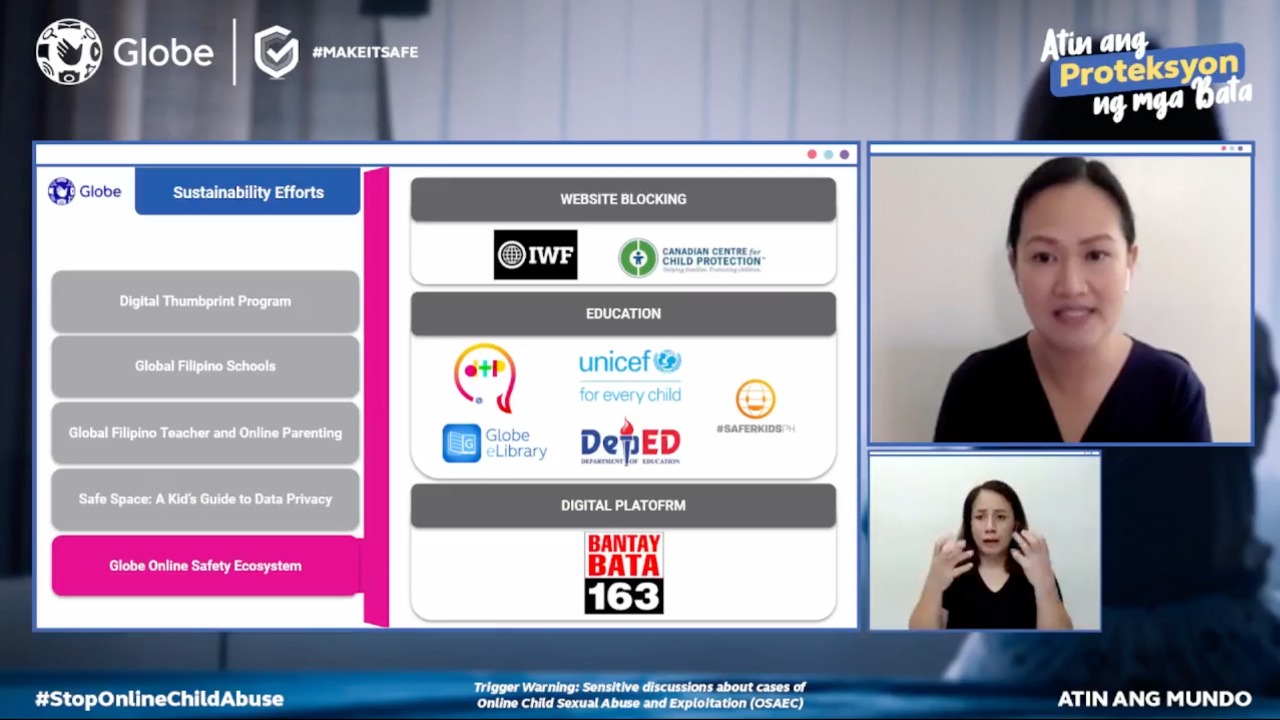
It takes a village to raise a child, but it takes even more to protect them. In a webinar marking World Safer Internet Day, Globe vowed to continue efforts to provide a platform for collaboration among key stakeholders to fight Online Sexual Abuse and Exploitation of Children (OSAEC).
The event was made open to the public via live streaming on Globe’s Bridging Communities Facebook page and was anchored on the digital solutions group’s #MakeITSafePH campaign, geared towards online safety and protection.
Together with partners from UNICEF Philippines and the SaferKidsPH Consortium, Internet Watch Foundation (IWF), CitizenWatch, and Bantay Konsyumer, Kalsada, Kuryente (BK3), Globe highlighted the importance of holistic cooperation among the public and private sectors, international and civil society organizations, and digital citizens in fighting online abuse and child sexual exploitation.
“As a digital solutions group, Globe recognizes the need for children to be safe online. We celebrate Safer Internet Day today with the intention of raising awareness and educating consumers about the continued rise of OSAEC in the Philippines, and what we can do to protect our children from further risks of online violence and exploitation,” said Yoly Crisanto, Globe Chief Sustainability Officer and SVP for Corporate Communications.
She cited how Globe has invested more than $2.7 million for content filtering systems that block websites and online imagery that promote child pornography and piracy.
“There is an urgent need to address online sexual abuse and exploitation of children, especially with the growing digital landscape,” said UNICEF Child Protection Officer Ramil Anton Villafranca.
He added, “We saw an alarming trend even before the pandemic that led to abuse which was further exacerbated by economic hardships during the pandemic. As a community, we need to create better opportunities that will enable our children and their families, without exposing them to the risks of abuse and exploitation.”
Emma Hardy, Communications Director of the Internet Watch Foundation (IWF) presented recent data from their 2020 report that found a dramatic 77% increase in the amount of “self-generated” abuse material as more children, and more criminals, spend longer online.
According to a study by the US-based National Center for Missing and Exploited Children (NCMEC), the Philippines is among the world’s top producers of content involving child sexual abuse.
Reports of online child exploitation have also risen during the pandemic, as struggling families resorted to producing illicit content using children to earn money quickly to make ends meet.
In the panel discussion, Atty. Tim Abejo of CitizenWatch highlighted how there are already existing laws that can help protect children exposed to the dangers of OSAEC, such as Republic Act (RA) 9775 otherwise known as the Anti-Child Pornography Act of 2009, RA 10364 the Anti-Trafficking in Persons Act of 2003, RA 10175 the Cybercrime Preventions Act of 2012, and RA 7610 the Special Protection of Children Against Abuse, Exploitation and Discrimination Act, more commonly known as the “Child Abuse Law.”
However, he also pointed out that these existing laws have several overlaps that could also be interpreted as contradicting, which could make pursuing a case more difficult.
Meanwhile, Professor Louie Montemar of BK3 talked about how the negative effects of OSAEC can stay with a child even beyond the years that they were exposed to these dangerous acts, as it can severely affect a child’s mental and physical well-being.
“Stopping OSAEC is everybody’s fight. As a staunch advocate for Internet safety, Globe has been working closely with government and key stakeholders to protect our children from sexual abuse online for several years,” said Globe Data Protection Officer Irish Salandanan-Almeida.
She added, “The only way for us to truly win this fight, is by working together across sectors and recognizing how we as individuals can play a part in preventing further cases of OSAEC in the Philippines.”
Globe strongly supports the United Nations Sustainable Development Goals, particularly UN SDG No. 9 which highlights the roles of infrastructure and innovation as crucial drivers of economic growth and development, and UN SDG 17 which highlights the value of partnerships to achieving the sustainable development goals. Globe is committed to upholding the United Nations Global Compact principles and 10 UN SDGs.










NEWS
Gen Z is Google’s most active users as AI transforms Search into an intelligent partner

6:50 p.m. April 26, 2026
Gen Z is now the most active generation on Search, a trend clearly reflected in the way people across Southeast Asia including Philippines are engaging with the platform. AI is taking Search beyond its foundation of providing information, transforming it into a truly intelligent partner.
Powered by Google’s most advanced multi-modal reasoning model Gemini 3.1, Search can have an intuitive, back-and-forth conversation and it will get people’s complex and highly nuanced intent.
As AI natives, this shift resonates with Gen Zs. They are no longer just entering keywords, they are researching, planning, brainstorming, and even having conversations with Search. AI-powered features like AI Mode and Search Live make it faster, more natural, and more intuitive to find and act on information, allowing people to search in multimodal ways including text, voice and visual. As a result, Gen Z has emerged as the most active generation on Search. Signed-in users globally aged 18 to 24 now issue more daily queries than any other age group. Google sees over 5 trillion searches annually with Gen Z driving this growth, showing Search is more relevant than ever
The Philippines’ young, AI-native population uses Search to expand their world and make decisions they can trust
In the Philippines, this shift is even more undeniable.
The country has one of the youngest, most AI-native populations in the world. Gen Zs lean heavily into Search, with 89% using it every day to make smarter, more intentional choices for a wide array of decisions. From researching on upcoming travel destinations to exploring the latest trends, this generation relies on Search to navigate the journey from curiosity to the final checkout—ensuring that they always make decisions that are guided by the reliable information they find online.
These days, social media might be where Gen Z discovers a trend, but Search is where they deep-dive about it and fact-check it. Instead of simply following a viral hype or long queues, they use Google reviews on Maps to find the truth behind the filter. They rely on Search to look up a brand’s history, find honest feedback, and compare prices to see if a product is actually worth the buzz. Search provides the credibility they need to make a move.
That’s because Search remains grounded in trust. When people use Search to ask questions, Google cross-checks AI responses and provides clickable sources for quick validation.
“As a travel content creator, I use Google Search a lot! I use it for my flights, not just to find a good deal, but to check which ones have less impact on the environment. It’s my way of traveling a bit more responsibly,” said popular Filipino content creator Arshie Larga.
“Plus it is my filter to avoid tourist traps! When I see a viral restaurant or food on social media, I make sure to consult Google Reviews,” he added.
“AI is the best thing that has happened to Search. Today, it can do much more than just provide information. AI is making Search more intelligent so it can converse interactively across formats and provide answers to people’s complex and nuanced questions. In Southeast Asia—home to one of the world’s youngest, most AI-native populations—we are seeing this shift play out in real-time. For this generation, Search has become a constant companion. They are engaging more deeply, visually, and through voice than any group before them. Whether it’s for learning, exploring a personal passion or making a high-stakes purchase, they rely on Search to make decisions they can trust,” said Sapna Chadha, Vice President, Google Southeast Asia and South Asia Frontier
Search is a natural extension of Gen Z fandoms and culture
For Gen Zs, Search is more than a utility. It is a digital home for their daily lives and passions. When it comes to what they love, Google is a natural extension of their fandoms, turning their curiosity into an immersive experience through hidden moments in Search called Easter Eggs.
From interactive trivia quests for icons like Taylor Swift, BTS, and the Southeast Asia Coachella sensation BINI, to adorable viral sensations like Punch the Monkey, Search speaks the language of Gen Zs. More than an intelligent engine, Search is part of the world that Gen Zs love.
Beyond these curated moments, Search reflects the real-time heartbeat of Gen Z culture through Google Trends. When a conversation starts buzzing, Trends allows people to tap into the pulse of the dialogue, providing the insights they need to join in and take action.
For Filipino Gen Z, nothing proved more powerful and buzzworthy than BINI ahead of their historic appearance at this year’s Coachella. “BINI Coachella” reached the top of the trends globally, as their “BLOOMS” fans celebrated the group bringing Southeast Asian Pride to the world stage.
To celebrate this historic momentum, Search on mobile now features a special tribute: searching BINI anywhere in the world triggers their signature ‘Ey’ gesture– the viral ‘hang loose’ write flick symbolizing confidence and positivity. It’s a testament to how Gen Z still trusts Search to open a whole new world of information and immersion for the culture, fandoms, and everything that they’re passionate about.
NEWS
Motorcycle taxi riders urge government to protect livelihoods, enact motorcycle taxi bill

1:11 p.m. April 25, 2026
Motorcycle taxi riders are calling on regulators and legislators to ensure that the protection of rider livelihoods remains at the center of any regulation governing the motorcycle taxi industry.
In a statement, Motorcycle Taxi Community Philippines chairman Romeo Maglunsod thanked the government for extending assistance to riders amid the continuing fuel crisis, saying the ₱5,000 aid provides meaningful relief for workers whose daily earnings are heavily affected by rising fuel costs.
“We are grateful for the assistance extended by the government to riders during the fuel crisis. For many riders, almost half of their daily income is already spent on fuel, and the ₱5,000 assistance is a big help,” Maglunsod said.
However, the group stressed that financial aid is only a temporary measure. It said long-term protection must come from policies that allow riders to earn decently, work with dignity, and continue supporting their families.
“At this time of crisis, no rider’s family should go hungry or suffer because of the lack of humane and stable livelihood,” Maglunsod said. “Any action from Congress must ensure the protection of the livelihoods of thousands of riders who work every day to provide for their families.”
The group said the passage of the motorcycle taxi bill is now urgent, noting that the government’s pilot study on motorcycle taxis has been running for almost a decade.
Maglunsod said any motorcycle taxi law must recognize the industry as part of the gig economy and must be anchored on the rights and interests of gig workers.
“What riders want is to remain the boss of their own livelihood. This means having the freedom to choose which platform to be active in, the ability to benefit from programs offered by different platforms, and the flexibility to strategize our own online hours,” he said.
The group also recommended that franchises or accreditation be granted directly to individual riders, similar to the model used for transport network vehicle service drivers, instead of placing riders under platform-held franchises.
Under this setup, Maglunsod said riders would have greater control over their own operations, while platforms would serve as tools that help them access passengers, incentives, and support programs.
“The rider should hold the power to decide how to earn a living. Platforms should be instruments that support riders, not structures that limit their freedom,” he said.
The group also underscored the public service role of motorcycle taxi riders, saying their continued presence on the road helps commuters get to work, school, hospitals, and other essential destinations.
“Every hour that riders are on the road means more Filipinos are able to travel, report to work, and reach the services they need,” Maglunsod said.
“Our call is clear: protect rider livelihoods, protect our freedom as gig workers, and pass the motorcycle taxi bill in a way that is fair, just, and humane,” he added.
NEWS
Gift of Life Rotary Club of San Juan West in action

6:33 p.m. April 22, 2026
For over 15 years, the Gift of Life program of the Rotary Club of San Juan West has provided life-saving heart surgeries and medical assistance to children with congenital heart disease, offering hope and a second chance at life to indigent families.
Through strong collaboration with local and international Rotary clubs, partner organizations, local government units, and dedicated medical teams at the Philippine Heart Center, the program continues to make critical pediatric cardiac care possible.
The initiative has also expanded its reach to remote communities through partnerships with grassroots groups such as the Heart Warriors of Ifugao, supporting patients from areas like Banaue, Ifugao.
This Rotary year, the program has assisted eight (8) children, with projections reaching up to ten (10) beneficiaries, alongside sustained fundraising efforts such as “Concert for a Cause” and other community-driven initiatives.
This Rotary year, the Gift of Life stands as a lasting legacy of Good President Emman Caguimbal, whose leadership strengthened the club’s humanitarian commitment.
The project is chaired by Past District Governor Augie Soliman, whose stewardship continues to guide its mission of restoring hope and saving lives.
Indeed, through Gift of Life, the Rotary Club of San Juan West continues to live out Rotary’s enduring promise: Service Above Self—one healed heart at a time.


Gen Z is Google’s most active users as AI transforms Search into an intelligent partner

Motorcycle taxi riders urge government to protect livelihoods, enact motorcycle taxi bill

All-new MacBook Neo launches at Power Mac Center