
TECHNOLOGY
Palo Alto Networks: Poor software supply chain impacts cloud infrastructure
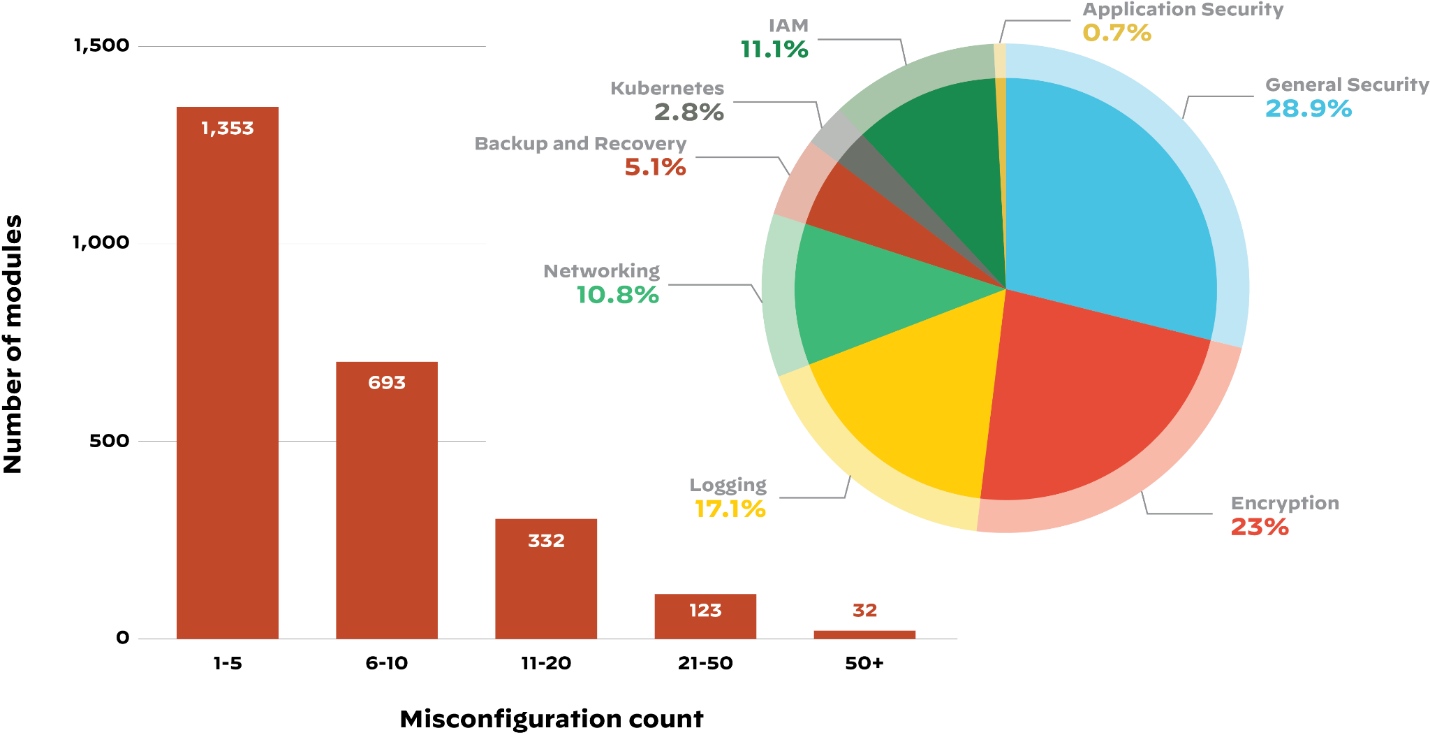
As an example of the prevalence of misconfigurations, Unit 42 researchers analyzed public Terraform modules by number of misconfigurations (left) and types of misconfigurations and their percentages (right). Source: Unit 42 Cloud Threat Report, 2H 2021.
Posted on Nov. 19, 8:48 p.m.
HIGH-PROFILE software supply chain attacks such as SolarWinds and Kaseya have shed a glaring light on the disparity between organizations’ perceptions of security within their cloud infrastructure, and the reality of threats in their supply chains that can impact business catastrophically.
In the latest Palo Alto Networks’ Unit 42 Cloud Threat Report, 2H 2021, Unit 42 researchers dive deep into the full scope of supply chain attacks in the cloud and explain often misunderstood details about how they occur.
They also provide actionable recommendations any organization can adopt immediately to begin protecting their software supply chains in the cloud.
The Unit 42 team analyzed data from a variety of public data sources around the world in order to draw conclusions about the growing threats organizations face today in their software supply chains.
Their findings indicate that many organizations may have a false sense of security in the cloud and in reality are vastly unprepared for the threats they face.
In addition to analyzing data, Unit 42 researchers were commissioned by a large SaaS provider (a customer of Palo Alto Networks) to run a red team exercise against their software development environment. In just three days, a single Unit 42 researcher discovered critical software development flaws that left the customer vulnerable to an attack similar to that of SolarWinds and Kaseya.
Key Findings
Poor Supply Chain Hygiene Impacts Cloud Infrastructure
The large SaaS provider detailed in the red team exercise has what many would consider a mature cloud security posture. However, during the exercise, Unit 42 researchers were able to leverage misconfigurations in the organization’s software development environment, such as the presence of hardcoded IAM key pairs, that would have allowed them to control all development processes and thus conduct a successful supply chain attack.Further, Unit 42 researchers found that 21% of the security scans they ran against the customer’s development environment resulted in misconfigurations or vulnerabilities, highlighting how process gaps and critical security flaws leave an organization exposed and susceptible to a business-halting attack.
Third-Party Code Is Rarely Trustworthy
In their research, Unit 42 researchers discovered that 63% of third-party code templates used in building cloud infrastructure contained insecure configurations, and 96% of third-party container applications deployed in cloud infrastructure contain known vulnerabilities. With this level of risk, an attacker could easily gain access to sensitive data in the cloud and even take control of an organization’s software development environment. Based on the Unit 42 team’s findings, it’s evident that unvetted code can quickly snowball into a security breach, especially as infrastructure flaws can directly impact thousands of cloud workloads. For that reason, it is critical that organizations understand where their code is coming from since third-party code can come from anyone, including an Advanced Persistent Threat (APT).
Conclusion: Organizations Need to Shift Security Left
Teams continue to neglect DevOps security, due in part to lack of attention to supply chain threats. Cloud native applications have a long chain of dependencies, and those links have relationships of their own. DevOps and Security teams need to gain visibility into the bill of materials in every cloud workload in order to evaluate risk at every stage of the dependency chain and establish guardrails.










TECHNOLOGY
Quick Flicks and Pro Clicks: Logitech brings fastest click technology with Latest PRO X2 SUPERSTRIKE

1:11 p.m. March 26, 2026
Logitech G raises the bar for competitive gaming performance once again with the launch of the PRO X2 SUPERSTRIKE, a next-gen wireless mouse that combines inductive analog sensing with real-time haptics.
Designed for elite precision and total control, the PRO X2 dramatically reduces click latency, enhances responsiveness, and gives players the power to personalize their click intensity like never before.
Industry-Leading Click Technology
Featuring a patent-pending SUPERSTRIKE technology, an industry-first innovation, the PRO X2 transforms how every mouse click is activated and felt. This new technology allows players to reduce the required travel distance to send the click signal. Improvements in click delay are shown to reach up to 30 milliseconds based on internal testing. This drastically transforms the way players compete and provides them the decisive edge they need to win virtual battlefields.
The PRO X2 introduces the Haptic Inductive Trigger System (HITS), which replaces traditional microswitches found in gaming mice. This system drastically improves click latency performance by sending tactile feedback to players so each click is felt the moment the signal reaches the PC.
By combining trigger response optimization with real-time click haptics, Logitech G sets a new benchmark in competitive mouse performance through the PRO X2.
Customizable Esports-Level Gaming Performance
Developed in collaboration with elite esports teams G2 Esports, NAVi, and BLG, the PRO X2 is made to meet the demands of high-level competitive play. Every element of the mouse is designed to support players in fast decision-making, precise execution, and unmatched consistency, whether competing in a professional environment or grinding ranked matches at home.
Beyond its impressive click system, the PRO X2 also introduces 10 selectable actuation steps, allowing players to fine-tune the actuation point of both main buttons. This level of control enables them to calibrate every click depth to match their preferred playstyle, role, or specific game requirements with zero hassle. These adjustments can be made seamlessly through Logitech G HUB software, giving them the flexibility to edit their settings without disrupting their momentum.
The PRO X2 also features LIGHTSPEED wireless technology that blends comfort and efficiency by delivering up to an 8 kHz report rate of untethered freedom. This end-to-end wireless solution ensures that every click and movement registers with exceptional speed and stability, earning the trust of esports professionals worldwide.
Precision Tracking Without Setbacks
Harnessing Logitech’s elite HERO 2 sensor, the PRO X2 SUPERSTRIKE enables a reliable 888 IPS tracking speed with sub-micron precision, up to 44,000 DPI mouse sensitivity, and over 88G acceleration. For players, this level of control not only supports quick wrist flicks and controlled micro-adjustments but also helps in split-second decisions that require fast reaction. Movements are assured to have zero smoothing, acceleration, or filtering, giving players the chance to showcase their raw and unfiltered skills.
Lightweight Design Built for Long Competitive Sessions
Following the award-winning design of the SUPERLIGHT 2, the PRO X2 weighs 61 grams to support fluid movements and long competitive sessions. Additionally, it comes with a long-lasting battery, reaching up
90 hours of constant use, to allow players to focus on their games without worrying about charge times.
The PRO X2 SUPERSTRIKE sets a new benchmark in player-controlled click innovation that redefines what competitive gaming hardware can deliver. Through Logitech’s advancing technologies, it brings together ultra-responsiveness and absolute control for a reliable wireless virtual performance.
Logitech G’s latest gaming mouse is priced at PHP 11,945 and is available exclusively on Shopee and Logitech Authorized Retail Partners and Gaming Specialists. To learn more about the product and upcoming product releases, follow Logitech G on Facebook. You may also visit http://www.logitechg.com for more product offerings.
TECHNOLOGY
OPPO Find X9 breaks barriers of mobile photography

9:22 a.m. March 24, 2026
Redefining what a flagship smartphone camera can achieve, the OPPO Find X9 sets a new standard for mobile imaging with its innovative capability to capture full-resolution 50MP photos by default, delivering unprecedented clarity without relying on shooting modes or manual tweaks.
This breakthrough delivers unprecedented clarity and detail, with 8K-level resolution across all three rear lenses every time you press the shutter, marking the brand’s biggest leap in camera innovation yet. It is designed specifically for creators, visual storytellers, and photography enthusiasts in mind.
Delivering Professional- Grade Quality with the LUMO Image Engine
While most smartphones downscale images to 12MP due to processing limits, the OPPO Find X9 overcomes this barrier with an industry-first imaging pipeline powered by the LUMO Image Engine. All rear cameras now capture crisp, ultra-clear 50MP photos by default, preserving deep textures, sharp edges, and rich detail even after heavy cropping or zooming. To fully appreciate its exceptional quality, users can tap the 8K icon that appears when viewing their photos in the default Photos app for a level of clarity and resolution previously only associated with professional cameras.
Meanwhile, LUMO’s real-time parallel processing enables the CPU, GPU, ISP, and NPU to work simultaneously, enhancing clarity while cutting power consumption by up to 50 percent. This results in balanced highlights, clean shadows, and impressive detail retention even in complex lighting conditions.
Refining Creative Expression Through the Hasselblad Master Camera System
At the core of the OPPO Find X9’s imaging capabilities is the Hasselblad Master Camera System, which brings professional-grade engineering to smartphone photography. The system includes:
- 50MP Main Camera with an ultra-large sensor for enhanced light intake
- 50MP Ultra-Wide Camera capable of capturing sweeping landscapes with zero distortion
- 50MP Periscope Telephoto Camera featuring OPPO’s Triple Prism Lens and 120x Super Zoom for astounding long-range shot results
The collaboration with Hasselblad ensures natural color calibration, beautifully rendered portraits, and deeper tones that reflect the iconic look of Hasselblad cameras. Features like Hasselblad XPAN Mode, Master Mode, and enhanced bokeh simulation provide depth and artistic control for creators.
Revealing True-to-Life Color Through Advanced Spectral Sensing
OPPO Find X9’s True Color Camera supports the 50MP default mode. It is an innovative sensor equipped with two million spectral pixels that analyze color temperature across a refined grid. This ensures that skin tones, neon signs, sunsets, and indoor lighting appear as close as possible to how the eye sees them, providing accuracy that is difficult to achieve on typical mobile cameras.
Colors are rendered naturally, without overly saturated processing, creating images that stand out in their authenticity and tonal balance.
Empowering New Perspectives With 120x Super Zoom
The OPPO Find X9 delivers dependable detail even at extreme distances through its 120x Super Zoom. Using a combination of optical zoom, sensor-level processing, and OPPO’s Super Resolution algorithm, the phone allows users to capture subjects far across the city skyline or fine details across a concert venue. Images remain clear and stable, unlocking creative perspectives normally accessible only with professional telephoto lenses.
A Fusion of Artistry and Engineering
The OPPO Find X9 embodies a design philosophy that brings together art, precision, and intelligent engineering. Its camera innovations are paired with a powerful performance core, ideal for Filipinos who rely on their smartphones to capture their stories.
The OPPO Find X9 (16GB + 512GB) is available nationwide through OPPO’s physical stores, e-commerce platforms on Shopee, Lazada, TikTok, and the official OPPO online store.
TECHNOLOGY
Designed for style: HONOR X8d arrives in PH for only P15,999

3:00 p.m. March 22, 2026
LEADING global AI smart devices provider HONOR Philippines today lifted the curtain on the new HONOR X8d, the latest addition to its acclaimed X Series line-up. Crafted to deliver an optimal experience to users, the HONOR X8d is priced at P15,999.
The new stylish smartphone integrates ultra-slim design, a robust 7000mAh battery, and stunning AI experience, representing HONOR’s dedication to provide well-rounded smartphones cater to the needs of consumers who desire a sleek, intelligent, and durable mobile device.
“The HONOR X8d is designed for today’s generation—where style is a statement and value matters. We’re proud to offer a smartphone that delivers both, making premium aesthetics and reliable performance more accessible than ever,” said HONOR Philippines Vice President Stephen Cheng.
Ultra-Slim Design with Class-Leading Battery Life
Introducing a 7.5mm ultra-thin and lightweight design, the HONOR X8d strikes a perfect balance between a smooth feel and elegant appearance. With advanced excimer technology and micro-nano textures, the body is extremely glossy and eye-catching, while the exquisite metal barrel adds extra embellishment to the back cover.
Powered by a large 7000mAh battery, the HONOR X8d provides price-level biggest 52 hours battery life verified by TÜV Rheinland and 6 years of endurance. The test data shows that the device can stand up to 31 hours of video playback on a single charge. With multi-point temperature monitoring, the battery shows great performance in temperatures from -20°C to 45°C, which allows it to work perfectly in various harsh condition. Additionally, the 45W wired HONOR SuperCharge can rapidly revive the battery for extended usage.
Fabulous AI Button for Brand-New AI Experience
Featuring a brilliant Instant AI Button, the HONOR X8d offers brand-new AI interaction through this subtle design. This physical side button enables users to quickly launch clean up and speed up commands and frequently used apps with a single press, providing much convenience in daily lives. Meanwhile, with a long press, users can activate more AI features such as Circle-to-Search, AI Subtitles, AI Writing, and Blur Private Info, delivering personalized and seamless user experience. Powered by the latest MagicOS 10 based on Android 16, the HONOR X8d carries various other intelligence features including Magic Capsule, Magic Portal, AI Memories, AI Settings Agent, and Google Gemini Assistant, making it the best partner for both work and life.
Exceptional Durability with Comprehensive Protection
Despite its extremely slim and lightweight body design, the HONOR X8d still showcases all-around drop resistance with SGS Premium Performance Certification of Drop & Crush Resistance, which ensures it can withstand drops from heights of up to 2 meters. Boasted with IP65 Water Resistance, the HONOR X8d can easily handle complex water environments including rinsing, splashing, and even high-pressure water guns. This device has been tested to function after being submerged in water for up to 1 minute at a depth of 0.5 meters, making it a dependable companion in various settings and situations. Additionally, with Wet-Hand Touch Enhancement, users can still have smooth experience even with wet or greasy fingers.
AI-Powered Smartphone Photography Experience
Packed with a stunning 108MP Ultra-Clear AI Camera, the HONOR X8d captures images with exceptional details and enhanced brightness, offering users both daylight precision and nocturnal refinement. With 3x Lossless Zoom, users can create stunning shots with diverse focal lengths, effortlessly creating different street vibes. With HONOR Connection, the HONOR X8d breaks the long-standing “drop-barrier” between different systems, enabling the device to share moving photo to iOS seamlessly. Additionally, the HONOR X8d integrates AI photography features like AI Eraser, AI Upscale, AI Cutout and AI Outpainting, which enable users to freely customize their image, streamlining photo editing on smartphones.
Enhanced Hardware for Superior Experience
The HONOR X8d features a 6.77-inch OLED Display, which supports 1.07 billion colors, a high refresh rate of 120Hz, and peak HDR brightness of 3000nits, delivering vibrant hues and incredibly fluid interface with exceptionally sharp and clear viewing experience. The device also boasts 6 eye-care technologies, including 3840Hz PWM Risk-free Dimming, Circadian Night Display, Dynamic Dimming, Comfortable Dim-light Adjustment, Low Blue Light and E-Book Mode.
Powered by the Snapdragon 6s 4G Gen 2, the HONOR X8d offers users a new level of system smoothness and higher graphical performance. This power efficiency is complemented by HONOR’s innovative RAM Turbo Technology, which effectively provides a 16GB RAM equivalent experience (8GB physical + 8GB virtual). It ensures smooth performance even after extended use, allowing users to multitask and switch between apps effortlessly. Additionally, the HONOR X8d comes equipped with 512GB large internal storage at most, providing ample space for years of precious memories.
Pricing and Availability
Catering to users’ diverse style preferences, the HONOR X8d is available in 3 captivating colorways: Light Blue, Velvet Black, Velvet Grey. Starting March 19 to 27, 2026, the HONOR X8d will be available for pre-order for only P15,999 with FREE HONOR Camping Light Speakers when you get from any HONOR Experience and Partner Stores. HONOR X8d is also available online via Shopee (https://bit.ly/Shop_X8d_PR), Lazada (https://bit.ly/Laz_X8d_PR), and TikTok Shop (https://bit.ly/TikTok_X8d_PR) with FREE HONOR Earbuds II.
Check out full specs of HONOR X8d here (https://bit.ly/Web_X8d_PR). In the meantime, for more exciting announcements, visit HONOR’s website www.hihonor.com, and follow HONOR Philippines on Facebook (Facebook.com/HonorPhilippines), Instagram (Instagram.com/honorph/) and TikTok: (Tiktok.com/@honorphilippines) for exclusive teasers, launch updates, and big reveal.


DigiPlus levels up user engagement with ArenaPlus’ P1B Prediction Giveaway

COA named WTO External Auditor, begins six-year term

What happened in Calvary 2000 years ago